How to Rent Property in Phuket: A Guide for Expat Families
LKG Team
Can foreigners rent property in Phuket?
Yes, without restriction. Under Thailand's Civil and Commercial Code, rental and leasing laws apply equally to Thai nationals and foreigners, and there is no minimum visa requirement to rent. Even tourists can technically sign a lease. That said, most families arrive on a Non-Immigrant O visa (accompanying a working spouse), a retirement visa, an LTR(Long-Term Resident) visa, or an education visa tied to their children's schooling, and it's worth having your visa situation sorted or well underway before committing to a long lease, simply so your tenancy term and visa term line up sensibly.
A small number of landlords are reluctant to rent to tourist-visa holders on very short stays. This is a landlord preference, not a legal barrier, and is usually easy to work around by explaining your longer-term plans.
Where to look
- Real estate agents: Agencies with a physical Phuket office and good reviews are worth the modest commission (usually paid by the landlord, not you) for the vetting, viewings and paperwork support they provide, especially useful for your first lease.
- Facebook groups: Groups like "Phuket Property Rent" and "Expats in Phuket" often have unlisted properties and let you negotiate directly with landlords, sometimes 20–30% below advertised rates. Be extra cautious here; verify ownership and never pay a large deposit before viewing in person or via a trusted video call.
- Property portals & Airbnb: Useful for shorter searches and getting a feel for an area, though prices often carry a premium versus a direct long-term lease.
- Local networks: Once you're settled, word of mouth through school parent groups and Ladies Kicking Goals members is often how the best-value, best-located places get found. Many never make it to a public listing.
What rent actually looks like, by area (long-term, monthly)
These are asking rents in baht a month, not signed prices. On 5 November 2026 we checked 166 long-term rental listings in Phuket on FazWaz, Thailand-Property, Lazudi, Livinginsider, expat.com and one agency site. Of these, 88 show a date and were posted or last updated within the 12 months before our check, and 78 show no date, so some may be older than they look. Typical means the range that held the majority of the listings we found, rounded. 2-bed condos are 45 square metres or larger (one listing shows no size). The sample is not random, and Bang Tao and Laguna account for almost a third of it. Where an area has only a few listings we give its lowest and highest asking prices instead of a typical range. Negotiation is normal, and view, furnishing and building age move the price a lot.
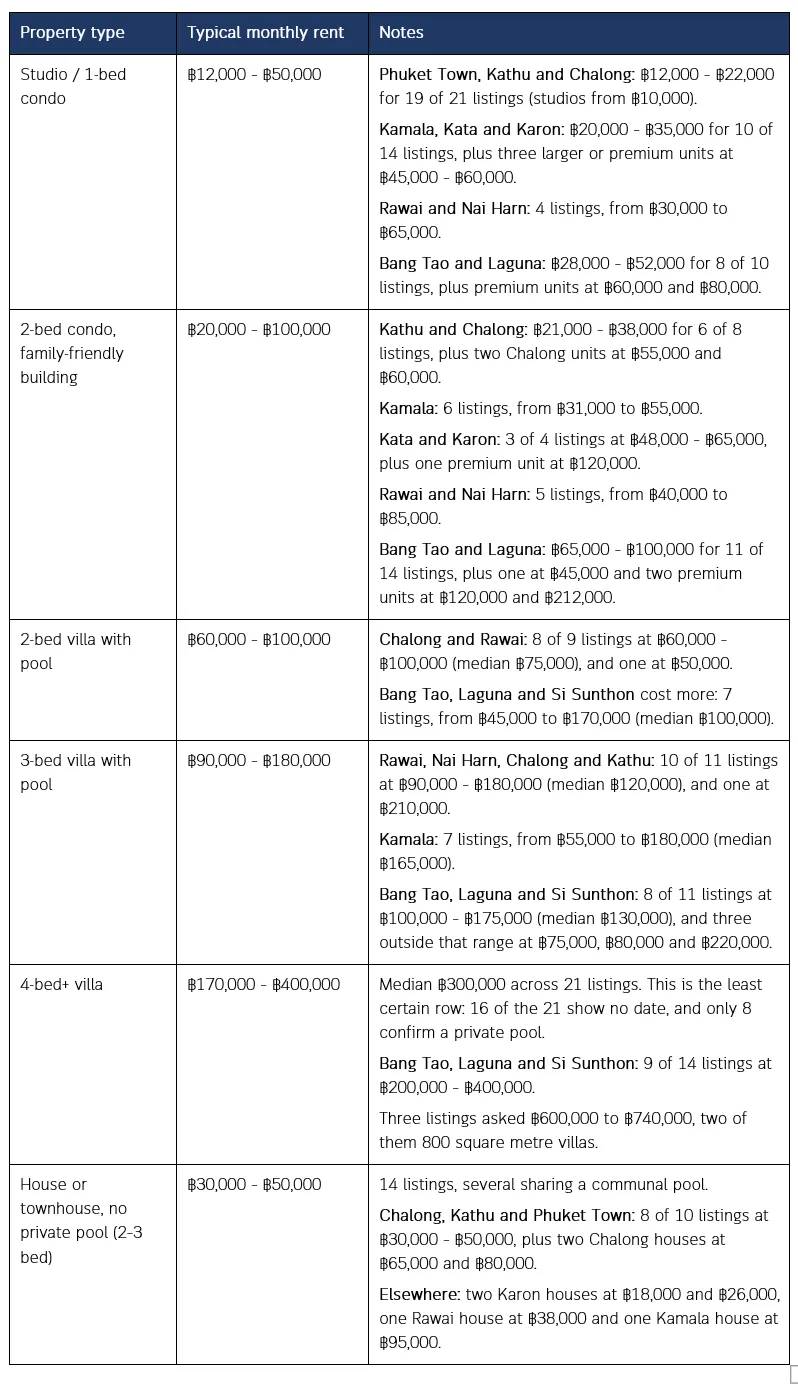
Where a listing showed both a 12-month price and a shorter-term price (one to six months), the 12-month price was 6–23% lower, around 10% in a typical case. That is only a handful of listings, so take it as a rough guide. We found no standard low-season (May–October) discount in the listings, so ask for one rather than expect it.
Deposits, advance rent and what's normal
The standard market practice in Phuket is two months' security deposit plus one month's rent in advance. So, budget for three months' rent as cash needed upfront. Since 2025, landlords classified as "business landlords" (those renting out five or more units) are legally capped at one month's deposit plus one month's rent, with a maximum 30-day notice period for termination and clearer consumer protections. Most individual condo or villa owners fall outside this rule, so the three-months-upfront norm remains standard for typical family rentals.
- Deposit return: Should be refundable within 30 days of move-out (7 days for larger landlords), minus any damage or unpaid bills. Normal wear and tear aren’t deductible.
- Lease registration: For houses and villas, leases longer than 3 years should be registered at the Land Office using the Tor.Dor.11(ท.ด.11) form for full legal protection. For a standard 1-year residential lease this isn't necessary.
- Contract language & payment: Insist on a bilingual Thai-English contract and pay by bank transfer rather than cash so you have a paper trail.
The step-by-step process
- Shortlist your area: Decide your area based on school, budget and lifestyle (see our Neighbourhood Guide), and set a realistic monthly budget including utilities.
- View in person: Always aim to see properties in person, or via a live video call if you're relocating from overseas. Photos alone are not enough, and this is the single best way to avoid scams.
- Clarify what's included: Confirm exactly what's included: furniture, appliances, internet, pool/garden maintenance, and whether electricity and water are billed at government rates or a marked-up private rate (villas especially can vary widely here. Always ask!).
- Negotiate: Politely negotiating on price, especially for a 12-month commitment or in low season, is completely normal in Phuket.
- Verify ownership: Confirm the landlord's identity matches the title deed (ask to see it), get everything in a bilingual written contract, and never hand over a large deposit in cash without a receipt.
- Pay and sign: Pay the agreed deposit and first month's rent via bank transfer, and keep all transfer confirmations.
- Confirm the TM30 filing: By law, your landlord must file a TM30 form with Thai Immigration reporting your stay within 24 hours of move-in. This matters for visa renewals and extensions. Confirm it's been done, and ask for a copy.
- Document the move-in condition: Take dated photos of the property's condition, and note any existing damage in writing, before you move your furniture in.
Common pitfalls to avoid
- A classic scam is a Facebook post using someone else's property photos, taking a large deposit, and disappearing or having a genuine tenant already in the property. Always verify before paying.
- Agents sometimes add a 10–15% markup versus dealing directly with an owner. Not really a problem in itself, but worth knowing so you can weigh the convenience against the cost.
- Villas often bill electricity at a private rate well above the government rate, particularly if a landlord runs a household meter. Ask for the exact rate per unit before signing, especially given how much air-conditioning matters in Phuket's climate.
- Get written confirmation of a rent-increase clause (or the absence of one) if part of your lease spans the November–March high season.
- Standard leases are usually 12 months; check the early-termination clause carefully if there's any chance your posting could change, since some landlords will forfeit your deposit for breaking a lease early.
A note on buying versus renting
Most families rent for the first year or two, even if they ultimately plan to buy. It's the best way to properly get to know an area before committing. If you do reach the point of considering a purchase, be aware that foreigners cannot own land outright in Thailand: condos can be owned freehold (within a building's 49% foreign-ownership quota), while houses and villas are typically secured via a registered 30-year leasehold (renewable) rather than direct land ownership. This is a much bigger legal step than renting and warrants independent legal advice. It's a topic for its own conversation once you're ready.
Rental practices, deposit norms and rates shift over time, this guide reflects typical current practice, but always confirm specifics with your agent or landlord and consider independent legal advice for anything beyond a standard one-year lease.